Career · journal · PR473
First job in Canada: notes and pay-stub check
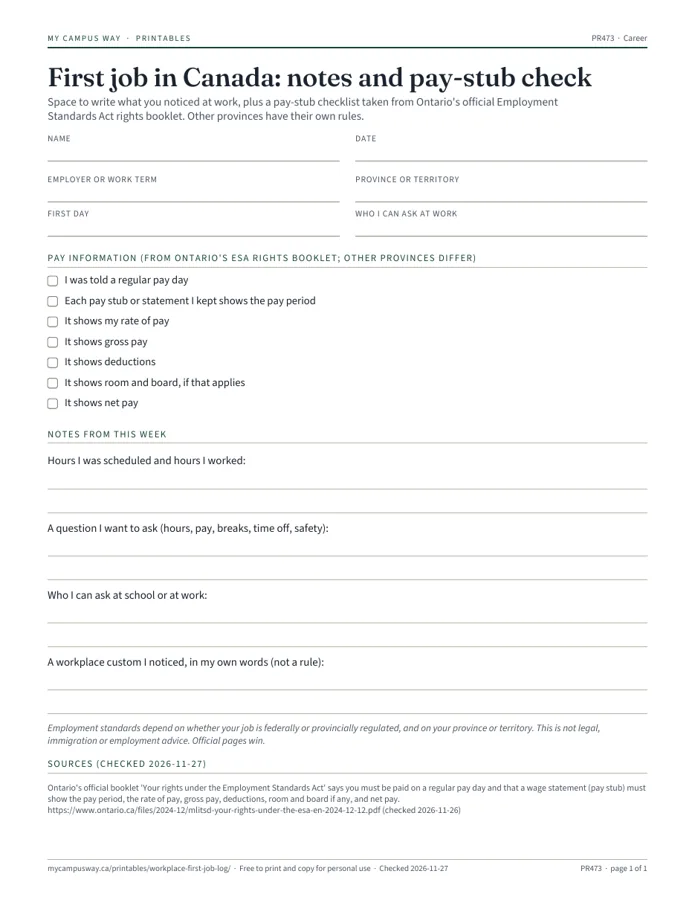
Space to write what you noticed at work, plus a pay-stub checklist taken from Ontario's official Employment Standards Act rights booklet. Other provinces have their own rules.
Download
- PDF, US Letter (fillable) · 50 KB
- PDF, A4 (fillable) · 50 KB
- Word (.docx), editable · 38 KB
- Excel (.xlsx), editable · 7 KB
The PDFs have fill-in boxes you can type into in a PDF reader, or print and write by hand. Both sizes print without scaling. The Word and Excel files are yours to change. Nothing is sent to us.
How to use it
- Keep each pay stub or electronic pay statement.
- Check it against the official employment-standards page that covers your job.
- Write questions down and ask a supervisor, a union steward if you have one, or your school's career or international office.
- If something looks wrong, use the official employment-standards complaint process for your jurisdiction.
What's on the sheet
Fill in
- Employer or work term
- Province or territory
- First day
- Who I can ask at work
Pay information (from Ontario's ESA rights booklet; other provinces differ)
- I was told a regular pay day
- Each pay stub or statement I kept shows the pay period
- It shows my rate of pay
- It shows gross pay
- It shows deductions
- It shows room and board, if that applies
- It shows net pay
Notes from this week
- Hours I was scheduled and hours I worked:
- A question I want to ask (hours, pay, breaks, time off, safety):
- Who I can ask at school or at work:
- A workplace custom I noticed, in my own words (not a rule):
Sources
- Ontario's official booklet 'Your rights under the Employment Standards Act' says you must be paid on a regular pay day and that a wage statement (pay stub) must show the pay period, the rate of pay, gross pay, deductions, room and board if any, and net pay. Source · checked 2026-11-26